
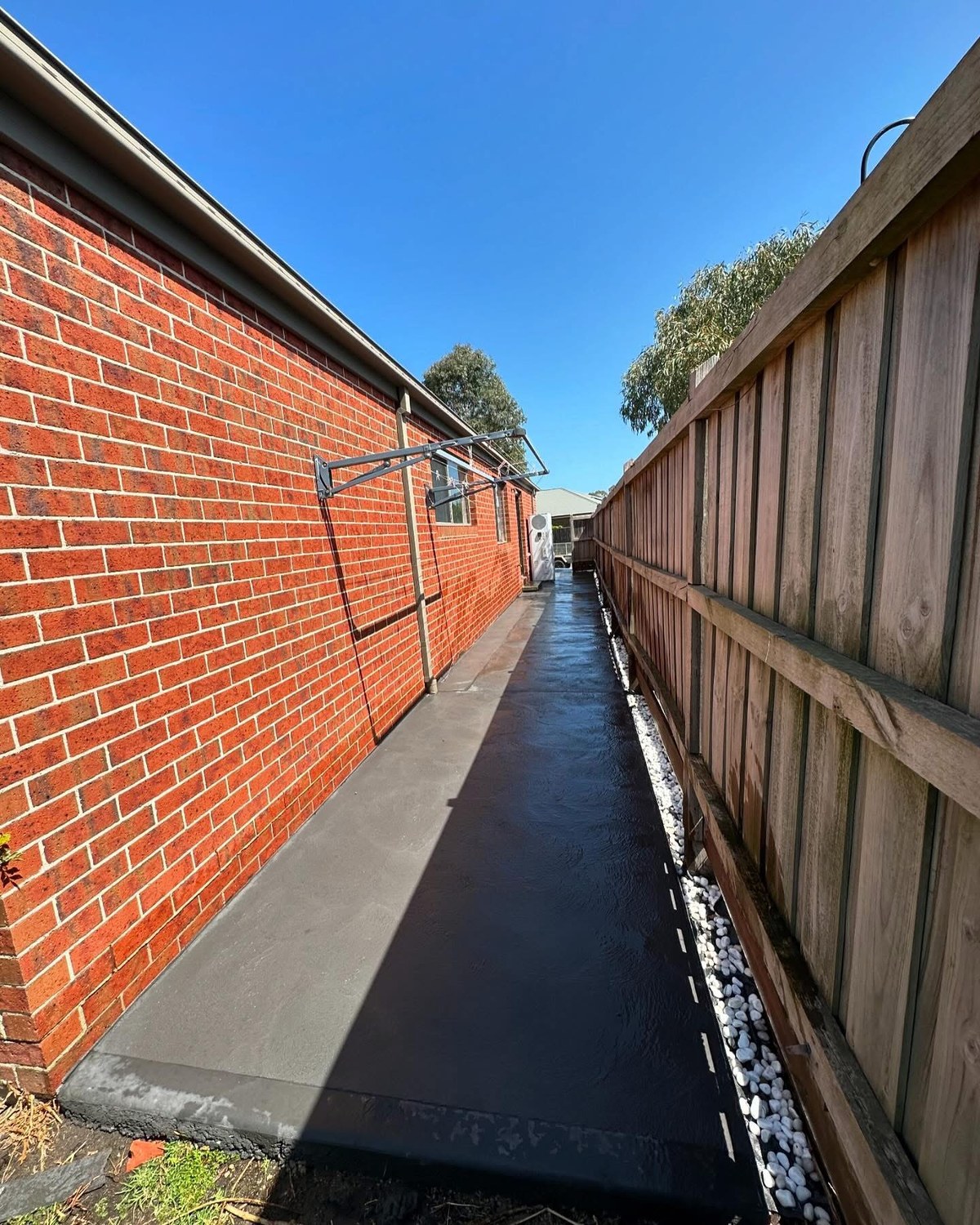
Water pooling in the backyard usually comes down to three things: ground with the wrong falls, drains that are blocked or missing, or downpipes with nowhere to go. Clay can make pooling worse because water soaks through it slowly.
Good backyard drainage solutions start with finding the source and a suitable outlet. A new pit or length of ag pipe can leave the same puddle behind if a downpipe still empties onto the ground or a path falls the wrong way.
Where the water is coming from
Most pooling has a source you can find on a wet day: a downpipe, a hard surface shedding water, a higher yard next door, or rain landing on ground with no fall. Work that out first, because each one has a different fix.
During or just after rain, look uphill from the puddle for one or more of these:
- Downpipes with nowhere to go. A downpipe that empties onto the ground, or into an old connection that has cracked or blocked, can concentrate roof runoff in one spot.
- Hard surfaces falling the wrong way. Paths, paving, a driveway or a concrete slab that sheds towards the house or into a garden bed with no drain at the low edge.
- Low spots with no fall out. A dip in the yard where the ground has settled or was never shaped to drain.
- Water from higher ground. A slope or a neighbouring yard that drains onto yours, especially along the boundary.
- Blocked or failed drains. An existing pit full of silt, or an old ag line that has filled with soil and stopped carrying anything.
Note where the water ends up too. A puddle against the house, a soggy lawn and a wet strip behind a retaining wall may need different fixes, even in the same yard.
Why Melbourne clay holds water
Clay drains slowly, so water can sit on top or just below the surface. Many parts of Melbourne's East and South-East sit on reactive clay, but we'll confirm the soil and drainage conditions on your block.
The topsoil may look fine while water collects above the clay underneath. It can move sideways towards a low point, such as a garden bed against the house or a corner of the lawn.
Soaking water into the ground through a soakwell or similar is often a poor fit on clay. We'll confirm whether soakage is an option on site. The usual approach on clay is to carry water to a suitable outlet rather than rely on it soaking away. Our guide to Melbourne's clay soils covers how clay affects walls, drainage and driveways in more detail.
Fixing falls and low spots
If surface water is the problem, the first fix is usually the shape of the ground. Paths, paving and garden areas need a consistent fall that carries water away from the house, paths and walls to a suitable outlet.
Sometimes a low spot needs reshaping. Sometimes a path or paved area needs to come up and go back down with proper falls on a compacted base. The fall depends on the surface, distances and outlet, so we'll confirm it on site.
Can I just add soil on top of a low spot?
Usually not on its own. Topping up a dip can move the puddle elsewhere unless the new surface falls to an outlet. Loose fill can settle again. Soil added against the house can also bring the ground too close to floor level or weep holes.
Raising a low area can be part of the fix. It just needs to be shaped to fall somewhere useful, compacted properly, and checked against the levels of the house, paths and any walls nearby.
Pits and ag lines
Pits collect surface water from a low point. Ag lines collect water that has soaked into the ground. Both only work if they are connected to an outlet the water can actually leave through.
A backyard drainage pit sits at the low spot where surface water gathers, with a grate on top and a pipe out the side. It can suit surface runoff at the bottom of a slope or the low edge of paving, provided the levels and outlet work.
Ag pipe drainage is a slotted pipe laid in a trench to pick up water moving through the soil. For it to work properly it needs:
- a steady fall along its length, so water keeps moving;
- clean gravel around it, so water can reach the slots;
- geofabric on clay, so fine soil doesn't wash in and silt it up;
- a real outlet at the low end.
A buried ag pipe that ends in the same wet corner, or just stops in the ground, hasn't solved the outlet problem. Check where the water can leave before deciding where the pipe goes.
Will an ag pipe on its own fix a soggy lawn?
Not necessarily. Water may be sitting at the surface, where an ag line alone won't address the falls. Depending on the source, the fix may combine an ag line with reshaping, surface pits or properly connected downpipes. We'll confirm which parts your yard needs.
Gravel strips beside paths and boundaries
A gravel strip along a path edge or boundary gives runoff somewhere to drop off the hard surface, and it helps keep soil and splash away from the concrete. It works best when there's drainage underneath and the path falls towards it.
On a side path, the concrete can fall away from the house towards the gravel strip. But gravel alone isn't an outlet. On clay, the strip can fill and hold water, so an ag line or pit may be needed to carry it away. We'll confirm the arrangement against the path levels and available outlet.
Two things to avoid. Don't send water onto a neighbour's land or out across a footpath, and don't let it run into the back of a retaining wall. Water trapped behind a wall is one of the main reasons walls lean or fail, which our guide on why retaining walls fail explains. Every retaining wall we build gets drainage: ag pipe, clean gravel and geofabric, taken to a suitable outlet.
The same thinking applies to driveways. If yours slopes towards the garage or house, see our guide to driveway drainage on a sloping Melbourne block.
Where is the water supposed to go?
Water from your yard needs a suitable outlet; the property's existing stormwater drainage may be an option, but we'll confirm. It shouldn't end up on the neighbour's side, across the footpath, or soaking into the ground against the house.
An existing stormwater line needs checking before it's treated as the answer. Whether a new pit or ag line can connect depends on the property's drainage. Older pipes may be cracked or blocked, so a visible downpipe connection doesn't settle the question.
When a stormwater connection needs a plumber
Where a new connection into the stormwater system is needed, that part is done by a plumber. We handle the yard side: pits, ag lines and falls. Council and authority rules on where stormwater can go vary, so check with your council if you're unsure, and we'll confirm what applies to your property during the quote.
For a new build or knockdown-rebuild, plan the drainage before paths and paving go in. Our guide to landscaping a knockdown-rebuild block covers that order of work.
Photos to take after rain
The most useful photos are taken during or just after heavy rain, from far enough back to show where the water comes from and where it ends up. Close-ups of a puddle on their own don't tell us much.
Next time it rains, take:
- Wide shots of the whole area from several angles, so we can see the slope and what surrounds the wet spot.
- The pooling itself, with something in frame for scale such as a step, a path edge or a downpipe.
- Every downpipe nearby, and where each one empties.
- Any existing pits or grates, showing visible silt or blockages.
- Paths, paving and the driveway next to the problem area, showing which way water runs off them.
- Retaining walls and boundaries close by, including any water coming through or along them.
- Access from the street or driveway, which affects how the work is done.
If you can, take a few the next dry day from the same spots. Comparing the two makes the low points obvious.
Drainage problems can be hard to judge from photos alone, so sometimes we need to see the site. Quotes are free and start from photos; if an on-site assessment is needed, it may be charged depending on project location and scope. Our drainage and site preparation work covers the falls, pits and ag lines discussed here.
You can send photos through our contact page.